Is there really a chance of randomly winning the lottery and getting rich overnight? In this article, we'll work out the actual odds of winning for people who play lotteries around the world, accounting for how the rules differ from game to game.

Naturally, everyone who buys a lottery ticket is dreaming of hitting the jackpot and getting rich as fast as possible. In most lotteries there's a single top prize category — the jackpot — and if more than one ticket matches the winning combination, the jackpot is simply split among the winners. One well-known exception among major world lotteries is Spain's national lottery and its close relatives, the New Year's El Niño and El Gordo drawings. Unlike typical lotteries, the Spanish lottery format hands out several top prizes rather than just one.
To correctly calculate the odds of winning a lottery jackpot, you need to work out the total number of possible combinations that could come up in the drawing.
To make that concrete, here's a table showing the jackpot odds for some of the world's most popular lottery formats.
| Lottery format | Rules | Odds of winning the jackpot |
|---|---|---|
| Mega Millions (USA) | 5 of 70 + 1 of 25 | 1: 302,575,350 |
| Powerball (USA) | 5 of 69 + 1 of 26 | 1: 292,201,338 |
| EuroMillions | 5 of 50 + 2 of 12 | 1: 139,838,160 |
| La Primitiva (Spain) | 6 of 49 + 1 of 10 | 1: 139,838,160 |
| EuroJackpot | 5 of 50 + 2 of 10 | 1: 95,344,200 |
| A typical 7/49 lottery | 7 of 49 | 1: 85,900,584 |
| A typical 4/20 + 4/20 lottery | 4 of 20 + 4 of 20 | 1: 23,474,025 |
| A typical 6/45 lottery | 6 of 45 | 1: 8,145,060 |
| A typical 5/36+1 lottery | 5 of 36 + 1 of 4 | 1: 1,507,968 |
| A typical 5/36 lottery | 5 of 36 | 1: 376,992 |
Further down, we'll walk through the formulas behind these numbers, along with worked examples for a few real lotteries. Keep in mind that in almost every modern lottery, besides the jackpot there are several lower prize tiers. Here's how that works: say a player matches 6 out of 7 numbers, or 5 out of 7 — they still win something, just a smaller amount than the jackpot.
To work out the odds of winning a lottery, we need a bit of combinatorics — but let's start with the math itself. A "combination" refers to choosing "k" elements out of "n" possible ones, where only the makeup of the combination matters, not the order in which the numbers are drawn.
The number of possible combinations is calculated as follows:
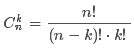
Let's take a typical 6-from-45 lottery as an example. The total number of possible combinations works out like this:

Once we know the number of possible combinations, we can talk about the odds of winning. It works out that matching all 6 numbers in a 6-from-45 lottery has odds of 1 in 8,145,060. In other words, the probability of hitting the jackpot in a 6/45 lottery is 1/8,145,060 = 0.000012277%.
A 6-from-49 format is popular in many European lotteries — you need to match 6 numbers out of 49 possible. Using the formula above, it works out that the odds of winning La Primitiva are 1 in 13,983,816.

Let's also work out the jackpot odds for a few other common lottery formats used around the world:
A "4 of 20" format lottery — the odds of winning are 1 in 4,845.

A "5 of 36" format lottery — the odds of winning are 1 in 376,992.

A "7 of 49" format lottery — the odds of winning are 1 in 85,900,584.

For lotteries like EuroMillions (rules: 5 of 50 + 2 of 12), where the drawing involves one or more extra balls, you simply multiply the number of possible combinations for the main balls and the extra balls together. The calculation looks like this:
The odds of matching all 5 main numbers out of 50 are 1 in 2,118,760.

The odds of matching both extra numbers out of 12 are 1 in 66.

Now we multiply the two figures together: 2,118,760 x 66 = 139,838,160. That's the odds of winning the EuroMillions jackpot.
So far we've only talked about winning the top prize — the jackpot! But every lottery also offers lower-tier prizes, awarded when a player matches only some of the numbers. What are the odds of winning one of those? The same formula applies. Let's work through an example using a typical "5 of 36" lottery.
| Numbers matched | Odds of matching |
|---|---|
| 5 | 1: 376,992 |
| 4 | 1: 2,432 |
| 3 | 1: 81 |
| 2 | 1: 8 |
With these numbers, we can also work out something else useful: the "return to player" rate — how much of the money taken in through ticket sales actually flows back out as prizes. Let's use our "5 of 36" example. The goal is to match 5 numbers out of 36. Instead of buying just one ticket, imagine buying 2,432 tickets, marking 5 random numbers on each. Say a single ticket in this hypothetical lottery costs around $1. That's roughly $2,432 spent in total. Based on the math, in the long run you'd typically expect one 4-number match, around thirty 3-number matches, and around three hundred 2-number matches. Multiply those by whatever fixed prize amounts the lottery pays for each — say $100, $10, and $1 respectively — and you'd end up with roughly $700 back. Divide $700 by the $2,432 spent, and you land on a return rate of about 28.8%. That's a rough illustration of how "return to player" percentages get calculated — the exact number naturally depends on a given lottery's actual prize structure and ticket price.
Looking at real published results from operators is a good way to sanity-check these numbers. In practice, many number lotteries report actual return-to-player rates in the same general range — often somewhere between 35% and 45% of total ticket sales, with the rest going toward the organizer's operating costs, taxes, and profit margin. The exact split varies a lot from lottery to lottery.
Put simply, most lottery operators keep a substantial share — commonly somewhere around half or more — of total ticket revenue as their own take, after covering the promised prizes.
Now let's work out the odds for another well-known lottery format — a classic 90-ball lotto game, where the ticket has two panels of 15 numbers each, drawn from a pool of 90 numbered balls. Each time a numbered ball is drawn, the matching number on the ticket gets marked off (assuming it's present).
Under this kind of format, the winning ticket is simply the one whose marked numbers match the balls drawn. In effect, this gives us a "15 of 90" lottery. Using the formula from earlier in this article, the number of possible combinations — and therefore the odds of winning — comes out to roughly 45,795,673,964,460,816 to 1, ignoring order.

As you can see, that number dwarfs the combinations in a standard lottery format like "5 of 36" or "6 of 45." The same holds true for major American and European lotteries — Mega Millions or Powerball, for instance. Their jackpot odds are also dramatically better than a 90-ball-style game like the one above.
One notable exception among world lotteries is the format used in Spain. Take the national El Gordo lottery, for example — every ticket sold is printed with a number between 00000 and 99999. That means the odds of winning for a given player come out to 1 in 100,000. Tickets, though, are sold in fractions. So, say, you might buy just 1 of the 15 available shares of ticket #51446. Other players can buy the remaining shares of that same ticket. If the jackpot is €15 million and ticket #51446 wins, your single share nets you €1 million. If you'd bought all 15 shares yourself, the whole jackpot would be yours.
Armed with this information — and the formulas covered in this article — we can now confidently answer the question so many players wonder about: "what are my actual odds of winning a substantial sum in the lottery?"
Keep in mind that the odds can vary enormously depending on the lottery's format, its rules, the ticket price, the number of players, and a range of other factors. It's clear that lotteries using extra-ball formats, or unusual formats like 90-ball lotto, tend to have noticeably worse jackpot odds than standard formats like "5 of 36" or "6 of 49." That said, it's worth remembering that European and American lotteries with extra-ball formats tend to offer prize pools far larger than most local lotteries.
One more interesting wrinkle worth mentioning before we wrap up: in the vast majority of cases, a single ticket won't be a winner — the numbers simply won't all line up. But that doesn't mean nobody wins a large prize; it just won't usually be you, on any single ticket. This is sometimes called the "lottery paradox." It seems that in games of chance, the outcome depends not just on the math, but on a healthy dose of luck too!
One thing is certain: the more tickets you buy, the better your overall odds of winning become.